Engineering careers
The US Tech Job Market: How Senior Engineers Can Show Their Value
Job-market headlines are broad; hiring decisions are specific. A practical way to connect your experience with the problems a team needs someone to own, without inflating your resume or chasing every keyword.
A market headline cannot describe every hiring decision
An engineer can read an optimistic employment projection in the morning and receive a rejection that afternoon. Both events can be real. The projection describes a broad occupation over years. The rejection concerns one company, one budget, one role, and a particular comparison among applicants. Treating either as the whole market makes it harder to decide what to improve next.
This article is a dated perspective, published November 4, 2026, rather than a live vacancies feed. It uses public occupational sources to explain categories and then offers an approach to presenting engineering experience. I would recheck the source period before reusing any number. A hiring plan can change much faster than an occupational handbook, and an applicant's location or work arrangement can narrow the relevant opportunity set considerably.
The practical task for a senior engineer is to make the match legible. What kind of system have you owned? Which decisions were yours? How did you verify the result? What would transfer to the employer's current problem? Those questions are more actionable than deciding whether “tech is back” or “tech is finished.” A focused answer gives both the candidate and the hiring team a better basis for a conversation.
Keep occupations, industries, and vacancies separate
The BLS Occupational Outlook Handbook projects 10 percent growth from 2025 to 2035 for software developers, quality assurance analysts, and testers as a combined group. Its separate computer-programmer category projects a 7 percent decline over the same period. These are distinct occupational classifications and long-term projections. Neither figure measures today's open senior backend positions in a particular city, and neither guarantees an individual offer.
The distinction matters because ordinary language blurs the categories. A person called a programmer at one company may do architecture and production ownership that another company assigns to a software engineer. Technology companies also employ nontechnical staff, while banks, hospitals, manufacturers, and other organizations employ software engineers. A headline about one industry should not automatically be read as a statement about every engineering occupation.
For a useful personal market review, I would sample actual roles within the candidate's realistic location, work authorization, seniority, and work arrangement. Record the required responsibilities and distinguish them from preferred tools. Repeat the exercise periodically with a consistent method. That small observation set cannot establish a national trend, but it can reveal whether a search is aimed at the right roles and which explanations the candidate needs to strengthen.
Sources: BLS: Software Developers, Quality Assurance Analysts, and Testers · BLS: Computer Programmers
Read the job description as an ownership problem
Consider a fictional senior engineering role that lists Python, Java, Kubernetes, SQL, and messaging. The list alone does not explain the job. The responsibilities might reveal that the team needs someone to stabilize partner integrations, reduce failed releases, and mentor engineers maintaining an aging service. A candidate who responds with five keyword matches may miss the reason the role exists.
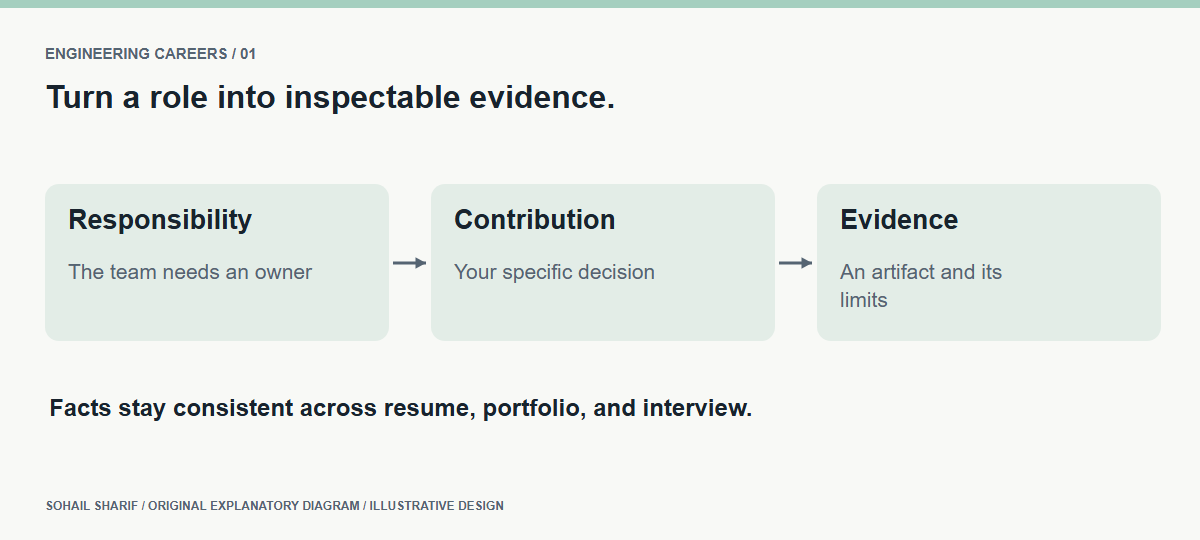
I would turn the description into a small evidence matrix. For each responsibility, record a relevant example, the candidate's actual contribution, the result, and any important limit. Mark an unproven tool or domain honestly. If the candidate has designed reliable background processing with one queue system, that can support a discussion of transferable reasoning. It does not establish years of production ownership of a different product mentioned in the advertisement.
This also improves the application itself. Lead with the closest evidence instead of a generic biography. A short explanation of the integration you owned, the failure mode you corrected, and the way you measured improvement is easier to evaluate than “passionate engineer familiar with modern technologies.” The goal is to make the connection explicit enough that a recruiter does not need to infer it from unrelated job titles.
Make seniority visible through decisions and consequences
Years of experience are useful context, but they cannot carry the entire seniority claim. A reviewer still needs to know what became easier, safer, faster, or more maintainable because of the candidate's work. An impressive number without a clear definition can be less persuasive than a modest result whose measurement and contribution are understandable.
For each strong example, I would write down the starting condition, the constraints, the choice made, and the observed result. If query latency improved, specify which workload and whether the number describes an average or a percentile. If a team delivered a platform migration, distinguish personal design ownership from the work completed by colleagues. If cost fell, state the measurement interval and whether usage changed at the same time.
Senior evidence also includes judgment that prevented unnecessary work. Choosing a modular service over a premature distributed design, delaying a risky migration until compatibility checks existed, or simplifying an operational workflow can be meaningful contributions. They need a concrete explanation of the tradeoff. A resume cannot hold every detail, but the candidate should be ready to discuss what they rejected, what they monitored, and what would make them reconsider the decision.
Build a portfolio that supports the conversation
A portfolio should help a reviewer inspect engineering thinking quickly. The most useful project page explains a problem, a small architecture, the candidate's contribution, a failure case, and a way to reproduce the important behavior. An attractive screenshot can invite attention. The supporting explanation determines whether that attention turns into a serious technical discussion.
For a fictional data-processing project, I would show the input contract, one validation example, the retry behavior, and a test that prevents duplicate output. For a cloud project, I would show the release boundary, permissions, health signals, and a bounded recovery exercise. Screenshots should represent actual artifacts or clearly labeled explanatory diagrams. A mock dashboard should never be presented as evidence of production scale.
Role-specific pages can emphasize different evidence while a main page keeps a coherent professional identity. A DevOps reviewer should find delivery and operational ownership; a backend reviewer should find contracts, data behavior, and performance reasoning. The underlying facts must stay consistent. Rewording emphasis is useful. Creating incompatible histories or presenting planned work as completed work weakens the very trust the portfolio is meant to build.
Tailor the story without manufacturing experience
Tailoring is an editorial task before it is a keyword task. Put relevant material where a reader will see it, expand a genuine example that matches the role, and remove distracting repetition when appropriate. Keep employer names, dates, responsibilities, and outcomes grounded in the candidate's records. A missing requirement is a gap to discuss, not an invitation to fabricate an assignment.
Suppose a role requires a warehouse platform the candidate has used personally but not in the listed employment. A skills entry can be accurate. A clearly described independent project may provide implementation evidence if it exists. Attaching the platform to a past employer and inventing a performance gain would create a different claim. The distinction matters during interviews, reference checks, and the first weeks of actual work.
I would also keep several examples ready at different levels of detail. A recruiter may need a concise account of scope and fit. A hiring manager may ask about ownership and collaboration. A technical panel may explore transaction boundaries or deployment compatibility. These should be different views of the same facts. Consistency makes a senior profile easier to trust and reduces the effort of preparing for each stage.
Treat interviews as a review of reasoning
Preparation becomes more useful when it resembles the work a senior engineer will actually perform. Choose an unfamiliar requirement, clarify it aloud, identify a reasonable first implementation, and examine what breaks under failure or change. Practice explaining why a simpler option may be sufficient. A memorized architecture is less convincing when the interviewer changes one constraint and the candidate cannot adapt it.
Prepare an incident or difficult delivery story with the same care. Explain what was known at the time, what evidence supported the diagnosis, how the blast radius was limited, and what changed afterward. Avoid turning every story into a heroic rescue. Recognizing a wrong hypothesis, asking for help early, or creating a safer process can demonstrate better judgment than claiming to have solved everything alone.
Questions for the employer are part of the evaluation. Ask what the engineer will own, how releases are approved, what production support looks like, and where the team currently loses time. The answers help determine whether the role matches the candidate's strengths and expectations. An interview is more informative when both sides discuss actual operating conditions rather than exchanging impressive but disconnected lists of technologies.
Turn one project into a credible interview artifact
Take a fictional background-processing service as a practice example. A weak portfolio description says it uses a queue, containers, cloud hosting, and several monitoring tools. A stronger explanation begins with the problem: customer imports could be accepted faster than they could be processed. It then identifies the engineer's contribution, such as defining a bounded queue policy and a visible status contract, and describes how those decisions were checked.
The supporting artifact can stay small. Show a queue-age chart from a labeled test workload, a sample rejected request when capacity is reached, and a recovery note for interrupted processing. State the environment and limits. If the exercise ran on a laptop with synthetic data, say so. A hiring manager can still evaluate the reasoning and ask how it would change with higher traffic, stricter availability needs, or multiple tenants.
Prepare a concise explanation and a deeper technical walkthrough of the same work. The concise version establishes relevance; the detailed version demonstrates ownership. Neither needs inflated production claims. A candidate who can explain why a particular failure matters, what evidence they collected, and what remains unproven gives the interviewer a useful basis for judgment. That is a stronger professional signal than an elaborate title attached to a project the candidate cannot explain under follow-up questions.
Improve the search using evidence from its stages
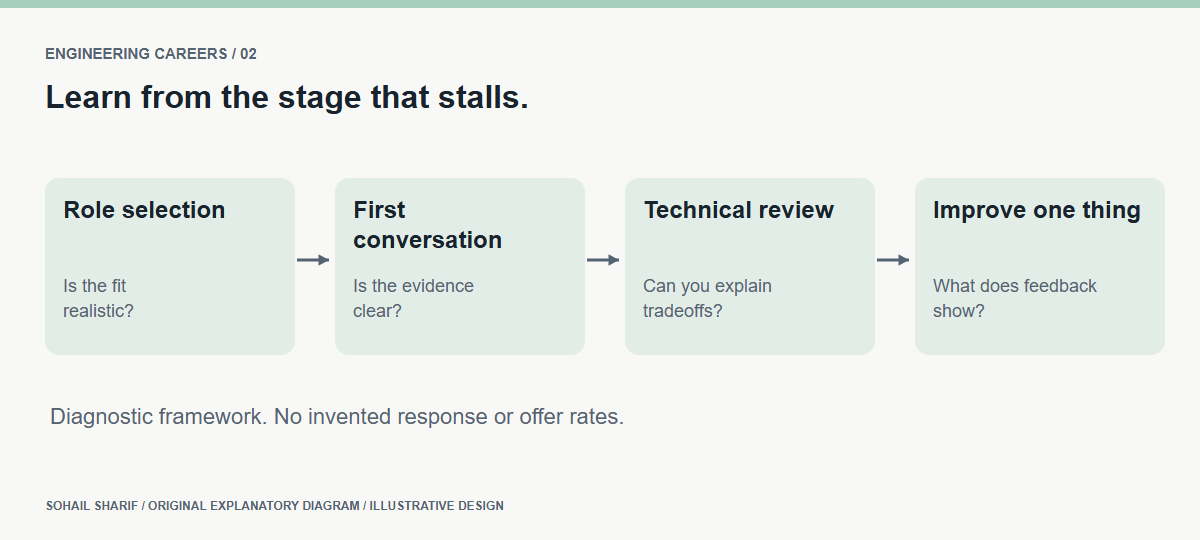
A search can stall for different reasons. Few initial responses may point toward role selection, unclear evidence, or a resume that hides relevant work. Strong initial conversations followed by weak technical rounds may suggest a need for deeper examples or practice explaining tradeoffs. A late-stage rejection can involve factors the candidate cannot observe. Do not force every outcome into one personal explanation.
I would keep a private, minimal record of applications and feedback, then review it on a regular schedule. Look for repeated patterns before making a large change. Rewrite one weak project explanation, ask a trusted reviewer to challenge a resume, or rehearse a specific technical discussion. Changing every document after every rejection makes it hard to learn which adjustment helped and can make an already tiring process more chaotic.
The US job market will keep moving, and public statistics will remain broader than any one person's situation. A strong professional profile cannot remove that uncertainty. It can make the candidate's value easier to inspect: accurate history, relevant ownership, understandable artifacts, thoughtful decisions, and evidence that survives technical questions. That is the part of the search an engineer can improve deliberately, without pretending to control the entire market.
Key takeaways
- Read long-term occupational projections separately from current local vacancies.
- Map each role to concrete ownership evidence and disclose the limits of that evidence.
- Use projects to show decisions, failure handling, and reproducible behavior.
- Diagnose the stage where the search stalls instead of rewriting everything after each rejection.