Software engineering
Beyond the Language: Engineering Principles That Travel Across Every Stack
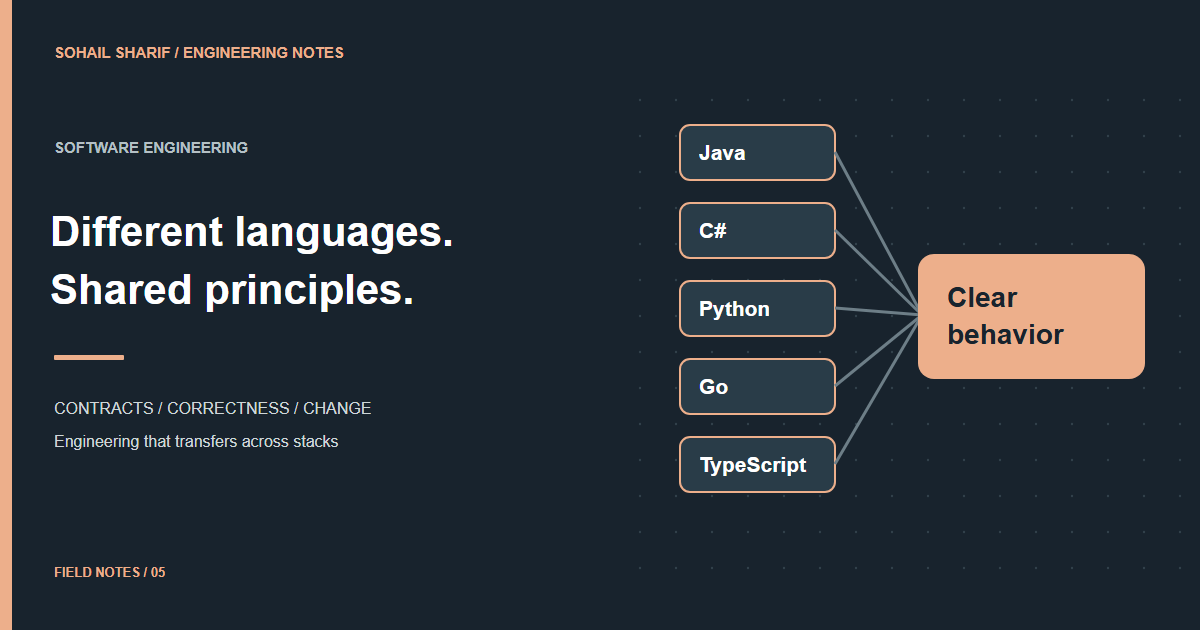
Java, C#, Python, Go, and TypeScript offer different tools. Reliable software still depends on clear contracts, correct state changes, useful tests, measured performance, and decisions another engineer can understand.
Keep language expertise and engineering judgment connected
A language matters. Its type system, runtime, libraries, concurrency model, and deployment ecosystem affect what a team can build and maintain comfortably. But knowing the syntax of several languages does not automatically demonstrate senior engineering. The deeper question is whether an engineer can preserve the meaning of a system while using the tools and conventions of its particular stack.
Consider a fictional inventory reservation service. A customer reserves stock, confirms a purchase, or lets the reservation expire. The implementation could use Java, C#, Python, Go, or TypeScript. The important business rule is unchanged: concurrent requests must not reserve more stock than exists, and an expired reservation must not silently become a completed purchase. Moving between languages does not remove those obligations.
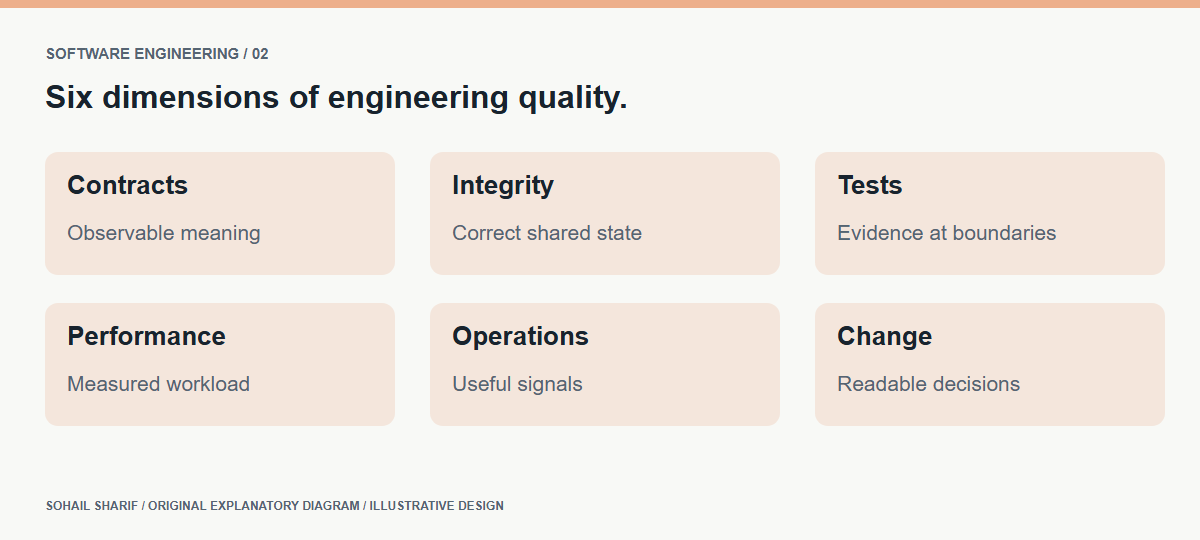
I would use that small service to evaluate transferable skills. Can the engineer state the contract, choose an authoritative store, protect a concurrent transition, test the failure boundary, and explain how the system is operated? Framework knowledge helps implement those decisions. Engineering judgment explains why they are needed. A strong professional profile can show both without pretending that every language should be used in exactly the same style.
Define the contract before the controller
A reservation endpoint needs more than a route name and a request class. What does success mean? How long is the reservation valid? What should the caller see if stock is unavailable? Can the request be repeated safely after a connection failure? Is the inventory identifier visible to every customer, or does authorization depend on the organization making the request?
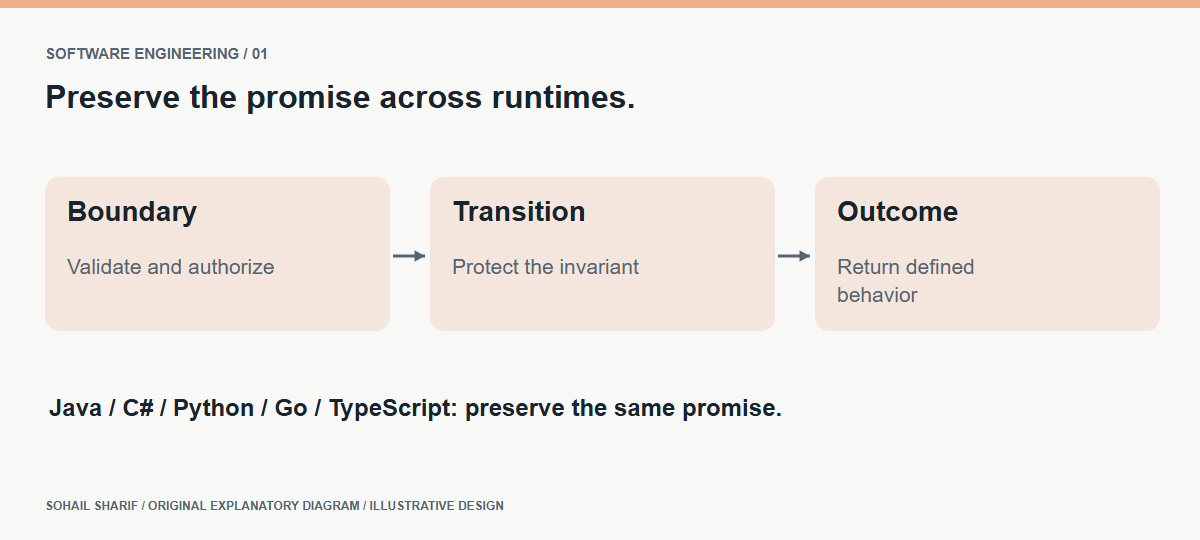
I would write a few concrete examples before choosing the controller abstraction. A valid request returns a reservation identity and expiry. A request for unavailable stock returns a defined outcome rather than an internal exception. A user from a different organization cannot inspect or cancel the reservation. A repeated submission follows a documented identity policy. These examples form a shared contract across the API, background workers, and user interface.
Types make parts of that contract easier to express, but an internal type is not a substitute for validating an external boundary. Inputs arrive from clients, databases, messages, and configuration. Each boundary needs an explicit interpretation of missing, invalid, outdated, or unauthorized data. The implementation language changes the available mechanisms; it does not decide the business meaning of an empty value or an expired permission on the team's behalf.
Model lifecycle and concurrency explicitly
A reservation has a lifecycle rather than a collection of unrelated update functions. Requested, active, confirmed, cancelled, and expired states have different legal transitions. A purchase confirmation racing an expiry worker must have a defined outcome. The service should not decide the result accidentally according to whichever thread happens to write last.
Write the transition rules in a form a reviewer can challenge. For example, confirmation requires an active reservation that has not crossed the agreed expiry boundary. Cancellation after confirmation may belong to a separate return process. Time should come from an explicit source with a documented interpretation, not from inconsistent local clocks hidden in several layers of business logic. These decisions become especially important when the service operates across time zones or retries delayed messages.
Concurrency tools differ across runtimes, and an engineer should learn their actual cancellation, scheduling, and resource behavior. The transferable habit is to ask who owns work, how it stops, and what shared state it can change. An asynchronous API does not imply that the database call is cheap. A worker pool does not imply that its queue is bounded. A thread-safe collection does not establish the correctness of a business transition spanning several operations.
Choose tests by the risk they can expose
A test suite should help the team make changes with evidence. For the reservation service, fast tests can verify transition rules and input examples. Database integration tests can verify uniqueness, conditional updates, and rollback behavior. A small number of end-to-end checks can establish that an authorized customer can reserve and confirm stock through the deployed interface. These checks answer different questions.
The Practical Test Pyramid describes the value of balancing tests across levels and avoiding excessive dependence on slow broad tests. I would apply that idea by placing each important risk at the smallest useful boundary. A hundred mocked repository tests cannot establish the behavior of the real transaction. A single browser test is a slow way to explore dozens of transition combinations. The suite should make those limits understandable.
Test names should describe behavior a teammate cares about. “Rejects confirmation after cancellation” is more informative than a name tied to a private helper. Include one adversarial example for every important boundary: unauthorized identity, duplicate input, concurrent change, unavailable dependency, or interrupted work. The objective is not a decorative coverage percentage. It is a reliable signal when a change violates a contract the team intends to preserve.
Measure performance in the context of the workload
Language comparisons often begin with a microbenchmark and end with a claim about an entire product. A reservation service may spend most of its time waiting for a database lock, making a remote call, or transferring data. Optimizing a small computation will not resolve those constraints. The first step is to identify where useful work is waiting and which resource is limiting completion.
I would define a representative request mix, including successful reservations, rejected reservations, cancellations, and expiry processing. Record latency distributions, completion rate, contention, database activity, memory, and queue age. Keep the dataset and environment alongside the result. If a change improves one percentile while increasing failures or starving another tenant, the review needs to show that tradeoff instead of announcing an unconditional improvement.
Runtime knowledge becomes valuable after the bottleneck is understood. Allocation patterns, blocking work, serialization, connection management, and scheduling may all matter, but in different ways across stacks. The engineer should form a hypothesis, measure it, change one relevant factor, and compare the result. The habit travels between languages. The specific optimization should respect the runtime rather than copying folklore from a different ecosystem.
Make dependencies and operations understandable
A service is easier to maintain when the business rule is not scattered across transport handlers, database adapters, and background jobs. That does not require a large collection of abstract layers. It requires enough separation to see which code decides the policy and which code communicates with an external system. A teammate should be able to change a reservation rule without tracing accidental behavior through unrelated infrastructure.
Operational clarity follows the same principle. Record a reservation identity across acceptance, confirmation, cancellation, and expiry. Use structured reasons for rejected transitions. Avoid logging customer secrets or creating unlimited high-cardinality metrics. A support engineer investigating a missing reservation should be able to distinguish a rejected request from an expired one without asking the original author to interpret a private log format.
Dependencies should have an owner and a reason to exist. A library that removes repeated complexity may be worthwhile; a package introduced for a trivial helper may create more maintenance work than it saves. Review updates for behavior and compatibility, not just version numbers. The professional standard is to keep the system understandable as people and tools change. That is as relevant to a small Python service as it is to a larger Java or .NET application.
Review the same requirement in two ecosystems
An instructive comparison begins with one requirement rather than two framework templates. For the reservation service, write the accepted and rejected outcomes, the stock invariant, the expiry rule, and the observation needed for support. Implement the contract in the ecosystem you know best, then ask what a second ecosystem would change about resource lifetime, cancellation, validation, and database access.
The comparison should expose decisions, not rank languages by preference. A different runtime may make a worker model easier to express while requiring different operational tuning. A framework may supply convenient validation while still requiring an explicit authorization policy. Keep the database assumptions visible so a reader does not mistake a persistence guarantee for a language feature. Where an implementation has not been built or measured, label the discussion as design reasoning.
Finally, run the same behavioral examples against both implementations if both exist. Compare the outcomes and inspect differences rather than assuming equivalent route names imply equivalent behavior. A rejected concurrent request, an expired reservation, and an unauthorized lookup make useful checks. This exercise demonstrates transferable understanding while respecting ecosystem differences. It gives a hiring reviewer a reason to trust the engineer's ability to learn a new stack without claiming that learning its conventions and production behavior requires no work.
Show depth without pretending every stack is identical
For a portfolio, I would present one well-explained implementation rather than five shallow copies with different logos. Show the contract, a concurrency test, a measured performance investigation, and a small operational guide. If a second implementation adds useful insight, explain what changed because of the runtime and what stayed invariant. A comparison becomes valuable when it teaches a decision, not when it merely repeats a CRUD screen.
In an interview, I would be comfortable distinguishing deep production experience from working familiarity. An engineer can explain how transaction boundaries transfer between stacks while acknowledging that a particular framework's lifecycle or deployment behavior still needs study. That honesty makes the transferable reasoning easier to trust. Claiming equal mastery of every ecosystem can make a genuine strength harder to evaluate.
Languages will continue to evolve, and teams will continue to choose different tools for valid reasons. A durable engineering identity rests on a recognizable way of working: clarify meaning, protect state, test the relevant boundary, measure real behavior, and leave the reasoning available for the next person. Those principles do not make stack expertise unnecessary. They make stack expertise useful to a team building software that must remain correct after its first successful demonstration.
Key takeaways
- Use concrete observable contracts to connect implementations across languages.
- Test concurrency and persistence rules with the actual database behavior.
- Choose tests and performance checks according to the risk and workload.
- Demonstrate runtime depth honestly while keeping transferable reasoning visible.