Cloud & reliability
From Commit to Recovery: What Production-Ready Cloud Engineering Looks Like
A green pipeline proves that its checks passed. Production readiness also needs safe identity, compatible changes, meaningful health signals, and a recovery path another engineer can actually use.
Begin where the deployment script usually ends
A deployment finishes, containers are running, and the pipeline reports success. Five minutes later, customers cannot complete a critical workflow because the new application expects data that the previous version never wrote. The infrastructure is available. The service is not fulfilling its promise. This fictional scenario explains why I evaluate cloud delivery from commit through recovery rather than treating deployment as the final outcome.
Production ownership joins several concerns that are often reviewed separately: how an artifact was built, which identity can release it, whether old and new versions can coexist, what signals indicate harm, and who can stop or reverse the change. Each concern influences the others. A release that is easy to trigger but difficult to diagnose can increase the team's operational burden even when its automation looks impressive.
For the rest of this article, imagine a small business application with an API, workers, a relational database, and object storage. The topology is illustrative. The goal is to explain the decisions a DevOps or platform engineer should make visible, not to claim that a particular tool or cloud architecture is mandatory. A modest service with clear ownership can be more mature than a larger platform whose failure behavior depends on undocumented knowledge.
Build once and make the release identity inspectable
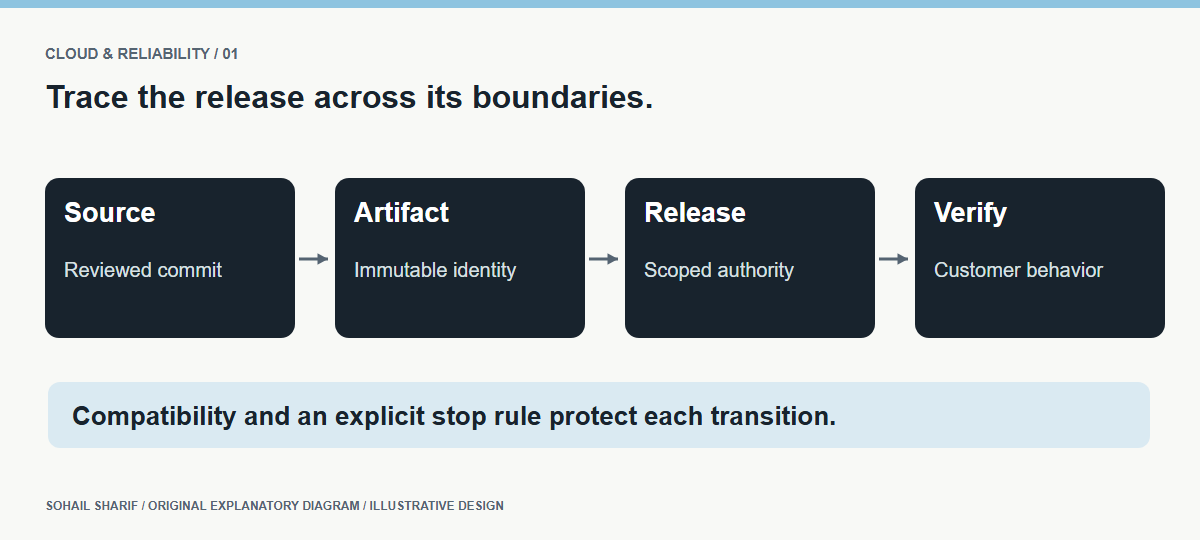
I want an operator to answer a simple question during an incident: which exact artifact is running, and why was it allowed into this environment? A source commit, build run, dependency resolution, artifact digest, and deployment record should connect into a traceable chain. Rebuilding separately for each environment weakens that chain when dependency or build inputs can change between runs.
The application artifact should move through environments without silently changing its contents. Environment-specific configuration remains explicit and validated. Secrets should not be baked into an image or printed into a build log. The release record needs enough information to reproduce the decision without storing sensitive values. If a team cannot identify the currently deployed artifact quickly, debugging begins with avoidable uncertainty.
Infrastructure changes deserve similar discipline. A reviewable plan should show the resources affected, the expected disruption, and dependencies outside the tool's control. A clean plan does not prove that a production change is harmless. It is an input to review. The engineer should also consider state protection, concurrent changes, drift, and the recovery consequences of replacing a persistent resource. Automation becomes useful when it exposes those decisions rather than hiding them behind one approval button.
Give automation the smallest useful authority
A build workflow that runs tests does not necessarily need production access. A preview deployment does not necessarily need permission to alter shared infrastructure. I would divide these responsibilities into identities with narrow scopes and clear lifetimes. The practical review question is what a compromised or mistaken step could change, not merely whether the workflow can complete its happy path.
Short-lived credentials and workload identity can reduce dependence on stored long-lived secrets, but the trust configuration still needs scrutiny. Which repository, branch, environment, or workflow may assume the role? Can an untrusted pull request obtain the same authority as a reviewed release? A policy that accepts too broad a subject can turn a modern authentication mechanism into an overly generous production entrance.
Operational access should be equally deliberate. Record which actions require elevated access, how that access expires, and where the audit trail lives. Avoid making ordinary deployment depend on a personal administrator account. During an incident, a clear access model reduces both delay and unsafe improvisation. The goal is to let the right person perform a bounded action quickly while keeping the scope and reason visible to the team afterward.
Make database compatibility a release condition
Rolling back application code is straightforward only when the surrounding state remains compatible. Imagine renaming a database column and releasing a new API while old workers are still consuming queued jobs. Those workers may fail immediately or, worse, write incomplete results. A container health check cannot establish compatibility between every producer, consumer, and schema version in that interval.
For this exercise, I would add the new field before requiring it, release code that can read both representations, backfill within a bounded workload, verify the results, and switch reads deliberately. Removing the old representation happens later, after confirming that no supported reader still relies on it. A migration record should describe the stop points and the assumptions that make a rollback safe at each stage.
Long-running workers and delayed messages belong in that review. A message created before the release can arrive afterward. A retry can execute code against a state that has already changed. Deployment gates should therefore include representative compatibility checks, not simply a successful migration command. If the change requires data repair rather than binary rollback, name that distinction in the release plan so an operator does not discover it during customer impact.
Observe the promise and use it to limit exposure
CPU usage and pod restarts are useful symptoms, but a release decision needs evidence of customer behavior. For the example application, I would identify the critical workflow and measure successful completion, latency, and delayed work at the boundary the customer experiences. Internal metrics then help explain changes in those outcomes. The dashboard should make both views available without asking an operator to infer business impact from infrastructure graphs alone.
Google's service-level objective framework connects indicators to the behavior users care about and to the level of service the team intends to provide. For a release review, I would use that idea to define a small number of explicit acceptance conditions. The thresholds in a real system need a baseline, a measurement window, and agreement on what should happen when the signal is inconclusive. They should not be invented as impressive-looking percentages in a template.
A gradual rollout can limit initial exposure, but only if routing and measurement distinguish the new version from the old one. A low-traffic canary may not receive enough representative requests to support a confident promotion. Background jobs may expose a failure later than interactive traffic. The release controller should be allowed to wait or stop when evidence is insufficient. Automatic promotion is not useful if the system cannot tell whether the trial actually exercised the risk.
Sources: Google SRE: Service Level Objectives
Control retries and overload before a dependency struggles
A slow dependency can create a release-shaped incident even when the new application has no functional bug. Requests stay open longer, connection pools fill, and retries create more work for the service that is already struggling. A dashboard may show activity increasing while useful completions fall. Increasing concurrency without understanding the bottleneck can accelerate the collapse.
I would review timeouts, retry limits, queue capacity, and per-tenant concurrency as a connected policy. The application needs a bounded amount of work in progress and a defined response when it cannot accept more. A queue should not become an invisible promise to finish an unlimited backlog. An operator needs the age of the oldest work, the rate of useful completion, and a safe way to reduce incoming pressure.
The AWS Builders Library explains why retries can worsen load and why jitter helps avoid synchronized attempts. In this application, I would also examine where retries occur so several layers do not multiply attempts unexpectedly. A repeated side effect needs its own safety contract. During a dependency incident, the responsible action may be to stop certain work and preserve its identity for reconciliation rather than continuing to retry until every resource is exhausted.
Sources: AWS Builders Library: timeouts, retries, and backoff with jitter
Prove recovery with a bounded exercise
A backup marked successful answers a narrower question than “can the service recover?” A useful exercise restores data into an isolated environment, checks its integrity, reconnects the application safely, and measures the time until a representative workflow works. The exercise should also establish what data was recoverable and which external side effects cannot be recreated simply by restoring the database.
AWS's reliability guidance emphasizes testing the resilience expected from a design. I would translate that into a small scheduled exercise with a defined scope, stop conditions, a responsible engineer, and a written result. Start with a realistic but contained failure. Do not create an uncontrolled production experiment to prove confidence. Record surprises, revise the procedure, and repeat the check after important architecture or operational changes.
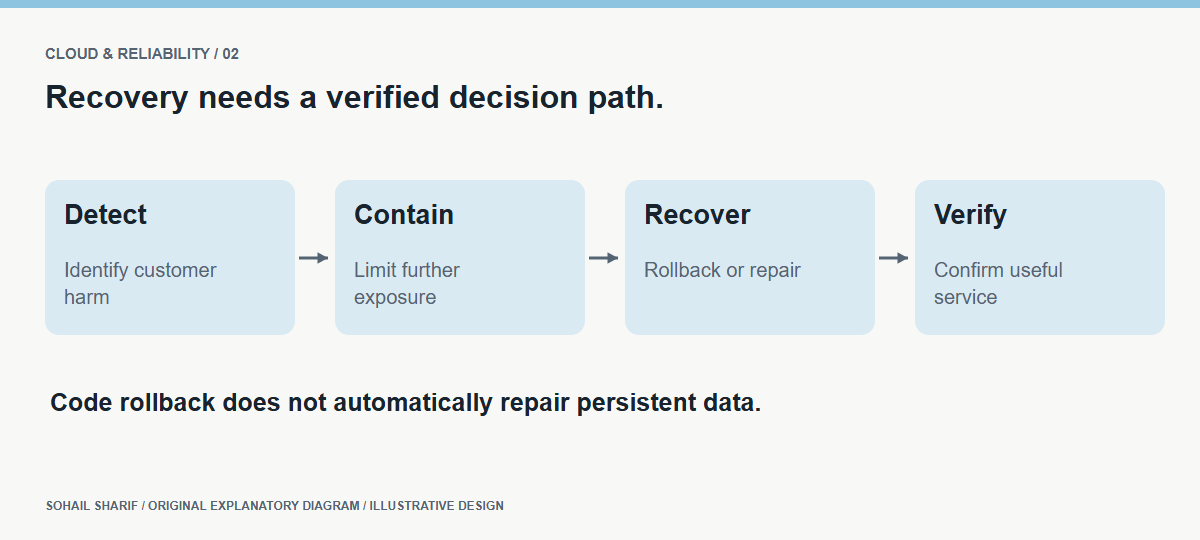
Recovery documentation should distinguish a service rollback, a data restore, a traffic change, and a repair of incomplete operations. Each action has different prerequisites and consequences. A runbook should say what evidence to capture, how to confirm improvement, and when to escalate. A procedure another engineer can execute with the intended permissions is stronger evidence than a plan whose success depends on the original author remembering several undocumented commands.
Sources: AWS Well-Architected: Test reliability
Walk through a failed release before advertising a safe one
For a practical demonstration, release a deliberately faulty version only in an isolated test environment. The fault could reject a known valid request while leaving the process health endpoint green. This separates infrastructure health from user-visible correctness. Define the affected traffic and stop conditions first, then show which signal detects the regression and which identity is allowed to halt the rollout.
Capture the artifact identity, the first relevant observation, the containment action, and the verification after recovery. If the test includes a database change, explain whether an old application version can still read the resulting state. Do not describe a redeployment as a successful rollback until the representative workflow works and persistent state has been checked. The exercise is valuable precisely because it can expose a recovery assumption the team had not tested.
Publish a compact evidence pack: the release plan, an annotated signal, the runbook, and a note describing what the exercise proved and what it did not. A local demonstration cannot establish regional disaster recovery or a production availability guarantee. It can demonstrate disciplined ownership of a bounded failure. For a DevOps portfolio, that complete explanation is more convincing than a collection of pipeline screenshots with no account of what happens when the checks discover a problem.
Make platform work easier to adopt and maintain
A platform is useful when it helps application teams make good changes with less repeated effort. A standard delivery template can provide sensible identity, observability, and rollback defaults. It should also explain which assumptions those defaults make. If every team bypasses the template to ship ordinary work, the platform team needs feedback about the friction rather than another layer of mandatory ceremony.
For a portfolio demonstration, I would show one complete path through the example service: reviewed change, traceable artifact, scoped deployment, a deliberately failed verification, and a safe recovery in a test environment. Include a short runbook, a clear cost boundary, and evidence from the exercise. Label synthetic traffic and illustrative diagrams honestly. A reviewer should be able to understand both what works and what has not been proven at production scale.
The senior contribution is the connection among these pieces. An engineer can explain why the pipeline has a gate, what signal makes a rollout stop, which identity may intervene, and how the team verifies recovery. Cloud tools change. The responsibility remains: help the organization deliver useful changes while preserving the ability to understand, limit, and recover from mistakes. That is the production readiness a green badge alone cannot demonstrate.
Key takeaways
- Connect the source commit, immutable artifact, deployment identity, and running version.
- Review mixed-version schema and message compatibility before a release.
- Use customer-facing signals and representative traffic to judge rollout safety.
- Demonstrate restore and recovery with bounded exercises and a usable runbook.